




From Grid to Chip: Engineering the 800V HVDC Power Architecture for AI Data Centers

The shift from 48V to 800V changes more than just the voltage level—it transforms how electrical power enters the data center, is distributed to server racks, and reaches the chips. Power supply architectures must simultaneously address efficiency, space, dynamic load, and reliability requirements, as every conversion stage and every transmission segment impacts the overall system’s performance.
At a recent seminar, Zuo Zhuang, Director of Power Management R&D at Luxshare-Tech, shared a presentation titled “From 48V to 800V: The Evolution of High-Voltage Direct Current (HVDC) Power Supply Architectures for Data Centers in the Era of AI Computing.” Drawing on high-voltage direct current (HVDC), solid-state transformers (SST), and power conversion solutions, he outlined Luxshare-Tech’s product portfolio and technical roadmap from grid to chip.

Zuo Zhuang, Director of Power Management R&D shared a presentation at a seminar
1. From Voltage Upgrades to Architectural Reconstruction
At the same transmission power, increasing the voltage reduces the current, thereby alleviating the strain on conductor current-carrying capacity and resistive losses. However, the value of high-voltage direct current (HVDC) can only be realized through the coordinated design of power distribution methods, the number of conversion stages, insulation protection, and backup power strategies. The evolution of the 800V architecture must also take into account existing facilities and operations and maintenance systems to form a phased implementation path.
The presentation covered three deployment models: rack-level, cluster-level, and data hall-level.
Rack-level: Adapts to existing AC infrastructure via independent power cabinets
Cluster-level: Provides centralized power supply through a power center;
Data hall-level: Designed for large-scale DC power distribution.
These three approaches cater to different retrofitting conditions and construction requirements; the key lies in aligning deployment scale, investment pace, and future scalability—rather than simply replacing equipment.
2. Using SST to Bridge Medium-Voltage Input and DC Power Supply
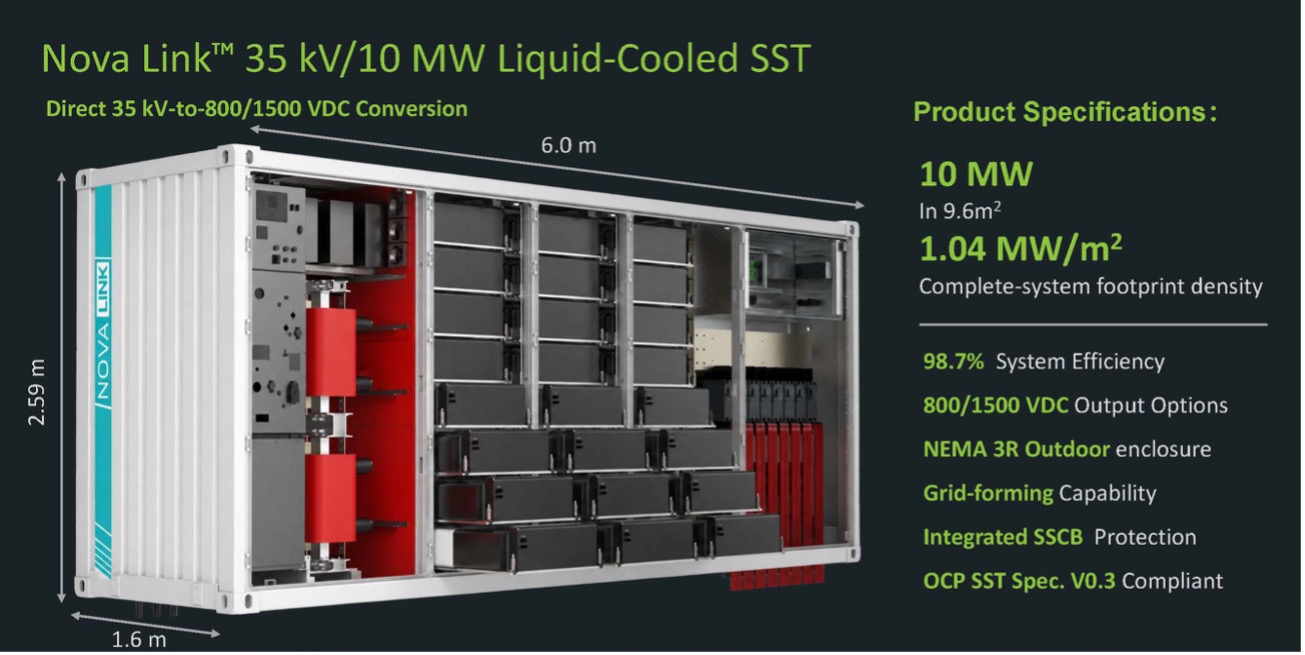
For facility-level power supply, solid-state transformers (SSTs) handle the power conversion between medium-voltage input and DC output. The Nova Link™ platform demonstrated by Luxshare-Tech features 13.8 kV/3 MW, 13.8 kV/6 MW, and 35 kV/10 MW solutions, covering both air-cooled and liquid-cooled configurations.
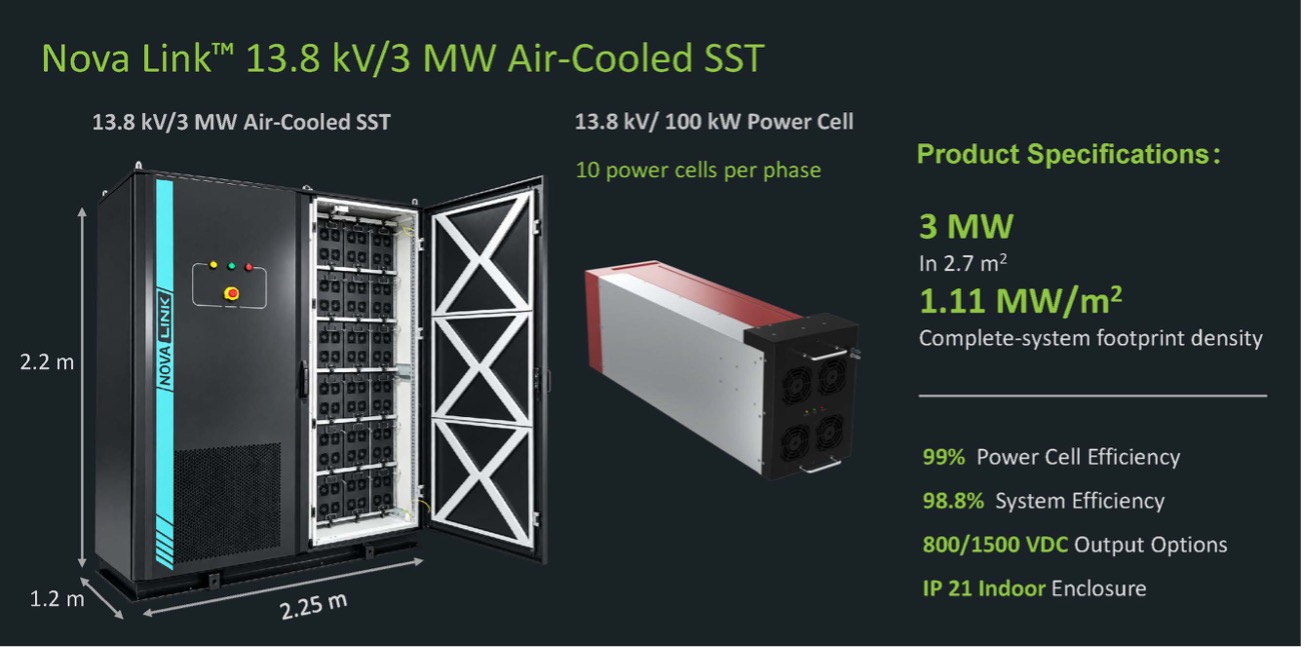
Among these, the 13.8 kV/3 MW solution is designed to achieve a peak efficiency of approximately 99% and is planned to occupy an area of about 2.7 square meters; relevant specifications are subject to confirmation through R&D validation. Achieving these goals requires addressing challenges such as high-voltage insulation, component losses, and heat dissipation. The platform employs high-voltage silicon carbide (SiC) devices, high-efficiency high-frequency transformers, and solid insulation technology, while utilizing resonant soft-switching to reduce losses during component switching. The module architecture—with input in series and output in parallel—is combined with distributed digital control and an N+X redundancy design to balance medium-voltage integration, power scalability, and operational reliability.
3. From Static Efficiency to Dynamic Adaptation
Beyond power supply efficiency metrics, another key question arises: Can the system respond promptly to sudden changes in load? From transient power demands on the computing side to bus energy allocation and input variations on the grid side, coordination across all stages is essential to minimize the impact of load fluctuations on the power supply system.
Addressing this need, Luxshare-Tech showcased solutions such as three-phase AC-to-800V DC and 800V DC-to-50V DC conversion, and plans to expand from 110kW power modules to megawatt-class power cabinets. In terms of conversion efficiency, technologies such as silicon carbide (SiC) devices, matrix transformers, and soft switching are used to reduce losses and increase power density; regarding dynamic response, busbar energy management, along with dynamic feedforward control on both the load side and grid side, are employed to address changes in power demand. Battery backup has also been incorporated into the overall plan. Battery backup units (BBUs), capacitor backup units (CBUs), and energy storage systems address energy demands of varying durations, providing short-term support and backup power, respectively. Only by coordinating power conversion with energy storage can different operating conditions—including normal operation, load fluctuations, and power outages—be addressed simultaneously.
4. Moving Closer to the Chips: Optimizing the End-Stage Conversion Path
Since chips require low-voltage power supplies, the 800V input must still be stepped down in stages after entering the rack. The presentation outlined a future-oriented approach: using HVDC modules to directly convert 800V to 12V or 6V, which then powers downstream voltage-regulating modules or vertical power supply solutions. This reduces intermediate conversion steps and positions the power modules closer to the chips.
This places comprehensive demands on the module, requiring a high turn ratio, high power, and a compact size. The R&D challenges outlined in the materials include an 800V input, a 6.25V output, a 128:1 conversion ratio, a power range of 10–20 kW, and an ultra-thin 6-millimeter structure. To address these challenges, Luxshare-Tech is exploring technologies such as gallium nitride (GaN) devices, matrix transformers, and high-frequency soft switching, while simultaneously optimizing PCB layout, thermal management pathways, and common-mode noise control. The closer the module is to the chip, the more critical it becomes to consider electrical performance, thermal management, and installation space in tandem.
From 48V to 800V, the upgrade of power supply architectures spans grid connection, rack power distribution, and chip power supply, requiring a comprehensive consideration of efficiency, reliability, and deployment conditions. In this presentation, Luxshare-Tech showcased its R&D and product roadmap—ranging from SSTs and rack power supplies to near-chip conversion and backup power systems—providing solution options for architecture upgrades at various stages. As related products continue to be developed and validated, Luxshare-Tech will further advance the integration of all components, enabling 800V power supply systems to better support the construction and expansion of data centers.


Contact Us
Ready to Get Started? We’re Here to Help.
Want to learn more about how we can work with you on your next project? Our global engineering and sales teams are here to answer questions, explore ideas, and help you find the right solution for your data center needs.


